


Links:
Some links to Thorncliffe in no particular order:
John Walker Perrott, (1814 - 1886) - built Thorncliffe.
John Walker Perrott was born in 1814, in birth place, to Samuel Perrott and Anne Perrott (nee Walker).
Samuel was born in 1768, in Wotton Under Edge Gloucestershire.
Anne was born circa 1785, in Richmond, Fermoy, Co. Cork, Ireland.
John had 7 siblings: Thomas Perrott, Samuel Perrott and 5 other siblings.
John married Isabella Susan Poole on month day 1859, at age 45 in Monkstown church.
Isabella was born in 1820, in Mayfield, Bandon Ireland, a daughter of wealthy land-owner (Mayfield, Bandon burned down in 1921 troubles).
They had 2 children: Marion Perrott and one other child, (daughter?)
John passed away on month day 1886, at age 72 in death place. (From www.MyHeritage.com)
 Samuel Perrot:
Samuel Perrot held an estate in the parishes of Castlelyons and Rathcormack, barony of Barrymore, county Cork, at the time of Griffith's Valuation, including the town of Castlelyons. Lewis writes in 1837 that Perrott had recently purchased the manor and was resident at Uplands in the parish. In the 1870s John Walker Perrott of Monkstown, Cork, owned 2,262 acres in county Cork.
Samuel Perrott married Anne Walker of Richmond, Fermoy, and they had a number of children including John Walker Perrott (1814-1886) who married Isabella Poole. See http://freepages.genealogy.rootsweb.ancestry.com/~parrott/carmarthenshire.shtml#i97
Samuel Perrott was residing at Cleve Hill in 1837 and in the early 1850s when the house was valued at £68 and held from Alexander McCarthy. Cleve Hill a modern family mansion on 13 acres was advertised for sale in October 1873, the estate of Joseph Gadsden Nash and Arthur Power Harty, bankrupts.
LightShip PUFFIN:
There is an interesting - if convoluted - link between Thorncliffe and the the lightship PUFFIN which marked the dangerous Daunts Rock about 5 nautical miles south west of Cork harbour. The PUFFIN disappeared in1896 after a hurricane and all 8 crew were lost. The famous Queenstown/Cobh salvor Henry Ensor dived, located and raised the wreck which he brought into Rusbrook, across the river from Monkstown, for the official inquiry that followed the tragedy.
Thorncliffe's architect Sir T.N.Deane was a direct descendant of Sir Anthony Deane (circa 1639-1720) who was considered by many to be a fine, technical naval architect and the first who could tell using his mathematical formulae the draught of ships from plans, long before they were launched. He wrote the seminal 'The Doctrine of Naval Architecture' in 1663.
Other direct descendants of Sir Anthony Deane were brothers John and Charles Deane who invented the worlds first diving helmet around 1823 and were the first to find on the famous MARY ROSE wreck (in 1836) and first to dive the ROYAL GEORGE raising cannons and other valuables from both. John Deane went on to carry out extremely dangerous anti-mining work in the Sevastapol during the Crimean War.
When Henry T. Ensor of Queenstown and his team dived and raised the lightship PUFFIN they did so using Deane's Diving Helmets. The inquiry found that the hurricane caused the light of the lightship to fall, crashing through the hull, opening a large hole that quickly sealed the fate of the ship and crew.
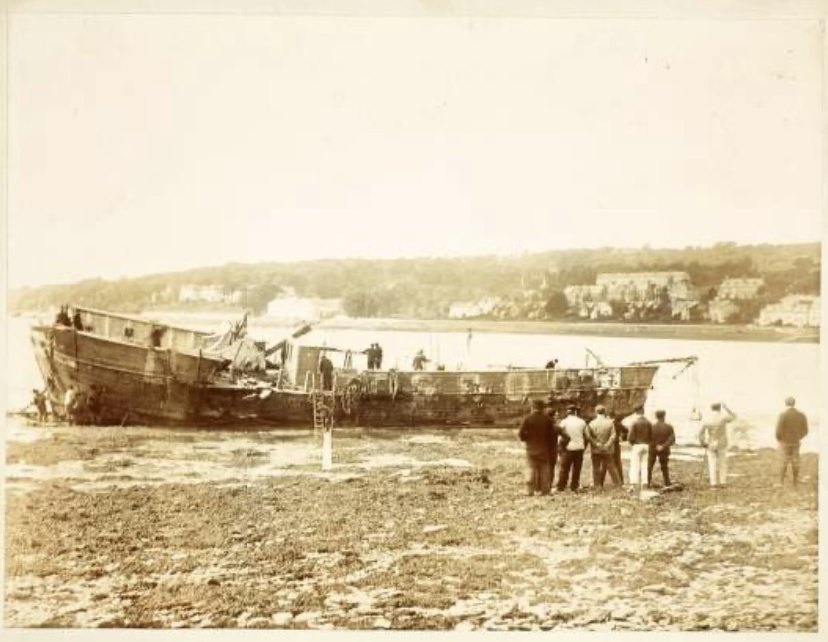
Above: Wreck of Daunts Rock lightship PUFFIN after being raised and brought to Rushbrook on 27/Aug/1897 for official inquiry. Monkstown and Thorncliffe in the background.
This wreck was still to be see in the early 1970's at Palmers Island, Ringaskiddy where Ensor had it moved to after the 1897 inquiry.
WW1:
Cork harbour was home to the fleets of both the Royal Navy and the US Navy in WW1. Present in the great harbour were destroyers, submarines, sub-chasers, airships, flying boats and both countries working under the british admiral Lewis Bayly - protecting convoys arriving and departing the so-called Western Approaches. The destroyers were often to be seen at anchor in Monkstown Bay with others craft.
Amongst the many stories from this time is first confirmed submarine sinking by the US Navy in WW1 - that of U-58 depth-charged and brought to the surface by USS FANNING on 17-Nov-1917. The FANNING came alongside U-58 and took aboard the german crew, saving them from certain drowning. One crew member was drowned when he jumped off the submarine as soon as she surfaced - his body was later found. However another crewman went below to scuttle the sub as his shipmates were being taken aboard FANNING and sadly he went down with the submarine thus making her wreck-site a war grave.
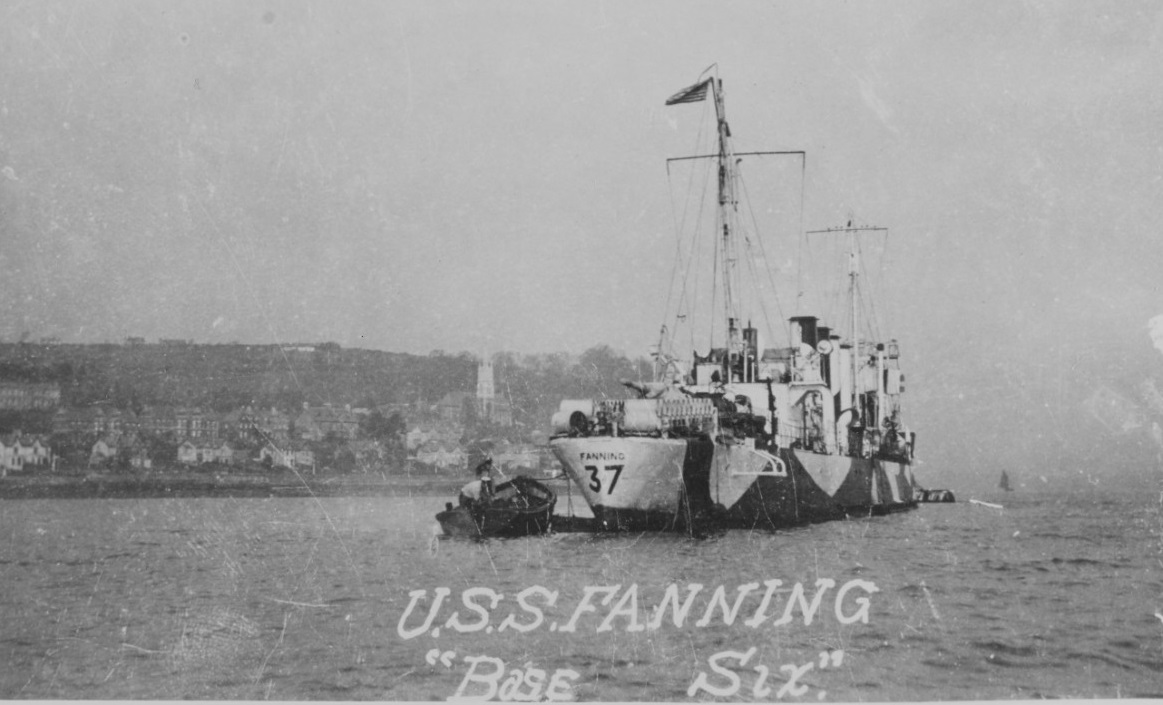
USS FANNING at her mooring at Monkstown with a launch attending at stern. THORNCLIFFE liest to the left just out of view of the photo.

17/Nov/1917: Photo taken from destroyer USS FANNING as she comes alongside the surrendered S.M. U-58 to take off survivors.
Meanwhile, still below, a german sailor is preparation to scuttle his submarine that will deny the US NAVY a valuable prize.
Another german sailor jumped from submarine immediately after she surfaced - he quickly drifted away and was drowned. A second german sailor succumbed to the wounds while he and his shipmates were being taken from the wrecksite back to Queenstown. The crew were thence interned in the War Prison Camp at Fort McPherson, Georgia, USA.
Some Web Links:
https://www.corkcity.ie/en/media-folder/heritage/a-guide-to-historic-ironwork-in-cork-city.pdf
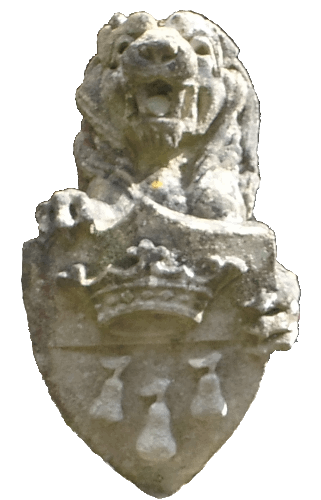
https://www.houseofnames.com/perrott-family-crest
https://historicgraves.com/st-mary-s-church-ireland/co-pwsm-0099/grave
https://web.archive.org/web/20161029012508/
https://deochandoras.com/1912-blencowe-rooper/
https://landedestates.ie/property/3479
http://www.dreadnoughtproject.org/tfs/index.php/Hugh_Blencowe_Rooper
https://landedestates.ie/estate/3095
"The Infernal Diver: The lives of John and Charles Deane", Bevan, John, reprinted 1997, Submex, ISBN-13: 9780950824215
https://www.limerickcity.ie/media/O'Regan, Hall.pdf (Newspaper Advert for Protestant Maid for Thorncliffe, 1869. Advertised contact was simply M.C., Thorncliffe).
https://www.galwaystonedesign.com/work-1/project-four-g5rfp (Recent Renovation Works to house and grounds.)